Curved Sliding Patio Door Options and Configurations
Glass Balustrades | Juliet Balconies | Galleries |
We continue to offer support to previous buyers of our doors, and all documentation and installation guides are available in the pages linked here.
For our existing Curved Door clients, should you need to contact us, please call 01342 410411, or email enquiries@balconette.co.uk quoting your order details, and we will be back in touch.
Almost Unlimited Possibilities for Curved Sliding Doors
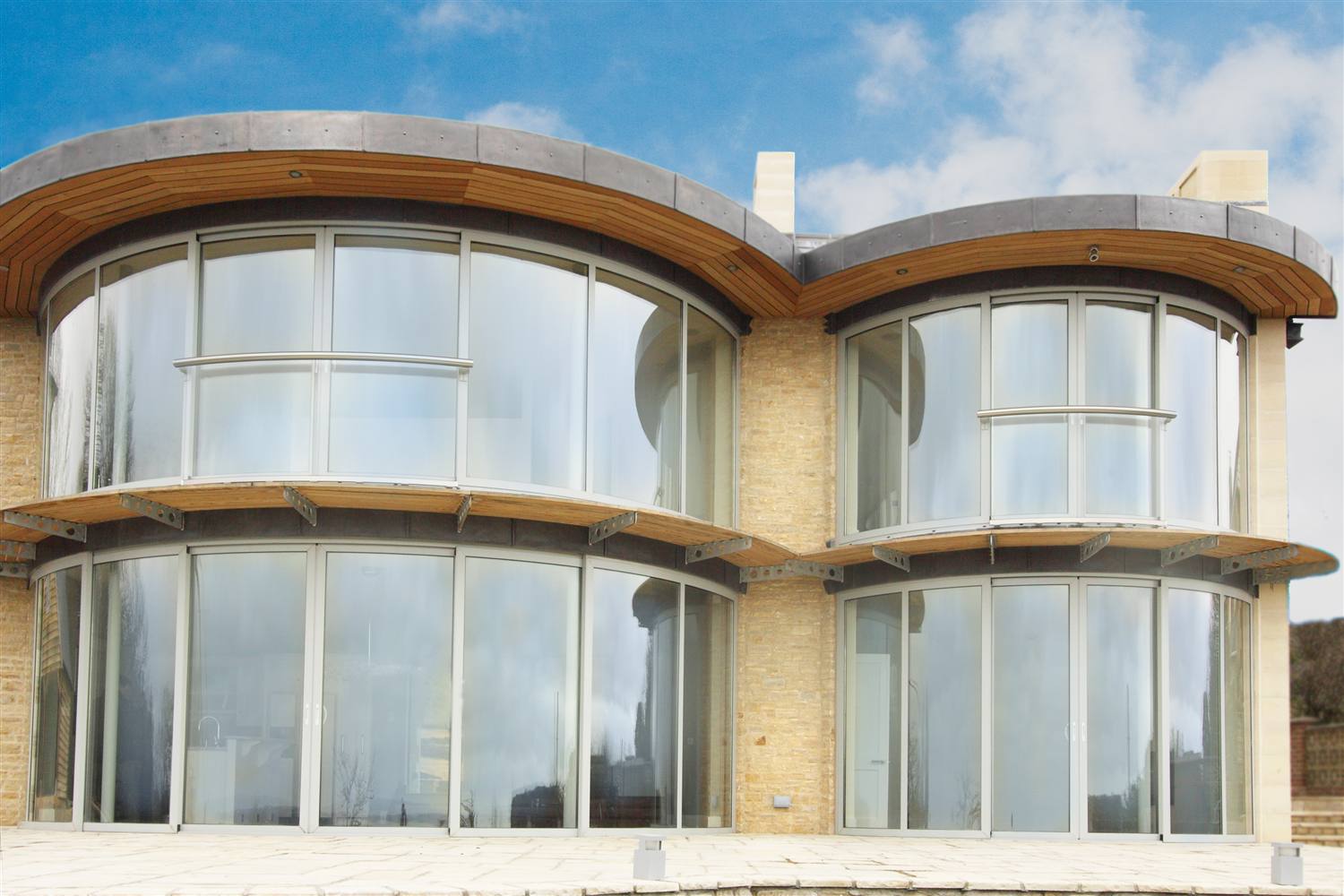
Here are Balcony Systems we have years of experience with manufacturing curved sliding patio doors. This experience has required us to find solutions to a vast array of situations for curved openings. From the simple two door solution to a requirement for a 13m long curved opening.
The solutions required are for:
* Maximum glass spans
* Minimum vertical divisions
* Minimum junctions
In order to meet these requirements we have developed an array of options that combine fixed and sliding panels using a flowing profile system that has neat and slim sightlines and maximum flexibility when combining these.
Fabrication Parameters Explained
Girth and height
Glasses employed in curved sliding doors have to be exactly curved to the precise radius; they must not have straight sections at the end of the bend and must have a very good optical quality. To achieve this, the bending and tempering machine must be very good and very precise.
We have found that the optimal sizes to achieve these parameters are curved glass panels that are no more than 1700mm (5 feet 7 inches) wide and at a maximum height of 2400mm (7 feet 10 inches)
The door frame is to be added to these and therefore the maximum recommended door frame girth (length measured on the curved) is not to exceed 1750mm (5' 7") that has an overall system height of 2600mm (8' 6").
Radius
It is very rare that we receive a requirement for a curved sliding door that has a very small or tight radius and typically you never see one that needed a radius that is smaller than 500mm (4 feet 11 inches).
In reality most curved doors have a relatively large radius. The level of expertise required in bending technology of the aluminium profiles is what will restrict this; same as the glass there are manufacturing limitations here too.
Being one of the most advance and versatile company in the field of curving aluminium and glass, we recommend and limit the minimum radius of curved sliding doors to 2500mm to the inside radius of the sliding track.
Fixed curved panels can be made to a smaller radius.
CurvedSliding Doors Options
There are many options available however we have tried to summarise these into ten popular options:
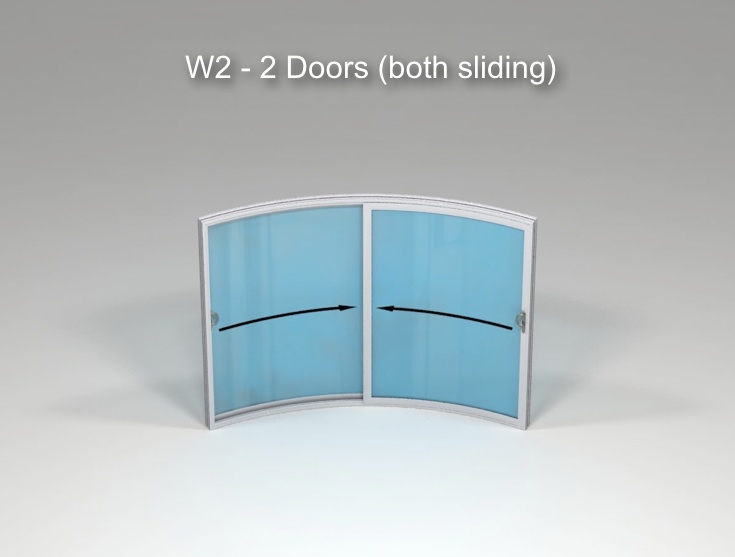
- W2 - 2 panes/doors that both slide (2 tracks) – appx 50% opening
- W2-F - 2 doors, one fixed and one sliding (2 tracks) – appx 50% opening
- W3-2F - 3 panes/doors, one that slides and two that are fixed (2 tracks) – appx 33% opening
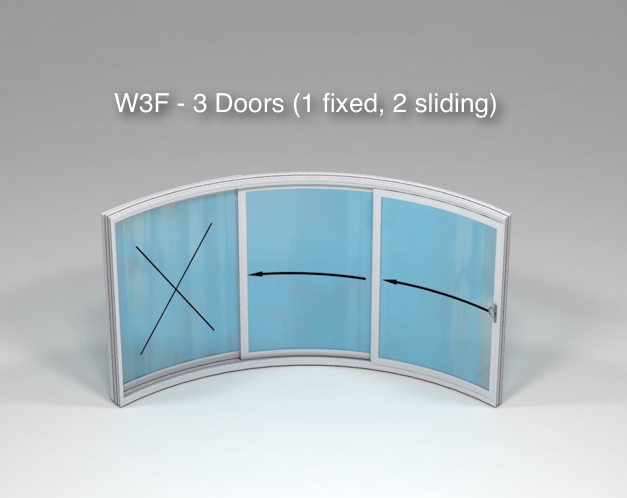
- W3-F - 3 panes/doors, two that slide and one that is fixed (3 tracks = 2 tracks + external fixed pane) – appx 66% opening
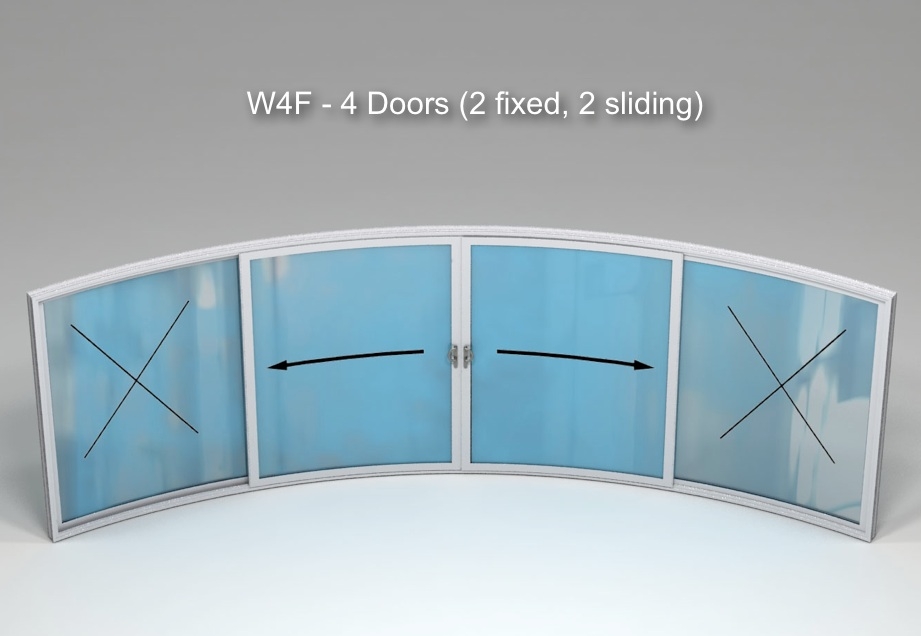
- W4-F - 4 panes/doors that 2 slide and 2 are fixed – doors meeting in the middle (2 tracks) – appx 50% opening
- W4 - 4 panes/doors that all slide – doors meeting in the middle (2 tracks) – appx 50% opening
- W6-F - 6 panes/doors, 4 that slide and two that are fixed – doors meeting in the middle (3 tracks = 2 tracks + external fixed panes) – appx 66% opening
- W6-4F - 6 panes/doors, 2 that slide and 4 that are fixed – doors meeting in the middle (2 tracks) – appx 33% opening
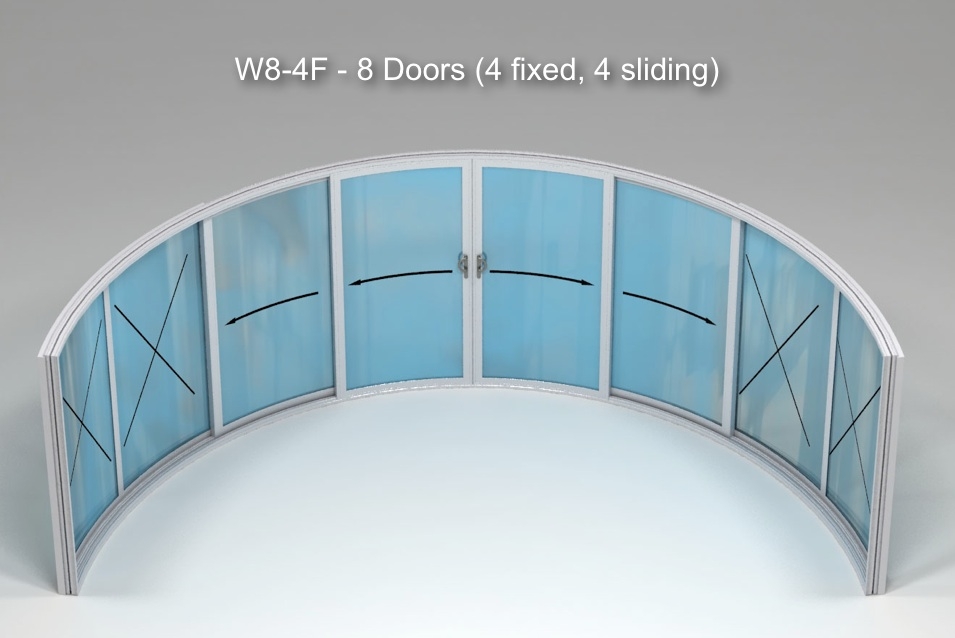
- W8-4F - 8 panes/doors, 4 that slide and 4 that are fixed – doors meeting in the middle (3 tracks = 2 tracks + external fixed panes) – appx 50% opening
- W8-6F - 8 panes/doors, 2 that slide and 6 that are fixed – doors meeting in the middle (2 tracks) – appx 25% opening
The basis is that there is a rail that has two tracks, any combination on this two track system will always give you a maximum opening of approximately 50%. Therefore you can have two sliding doors, and any one of these will be open at any one time. Or you can have four sliding doors, meaning any two can be open at any one time. In the same fashion you can have part of the doors fixed to the track and part sliding, so to give an example you could have four sections, two sliding and two fixed and still maintain your maximum 50% opening.
Sometimes you can have very large openings and these "fixed" doors can be made very large with vertical division mullions within. This will give you the appearance of a continuous curved door frame and you can have for example a 10m (33 feet) long curved door frame with two central doors that lock into each other and slide with the rest being a large fixed panel made of several glass sections.
In addition to using a two track system there is a way to add a fixed panel onto the outside of the rail and thus increase the possibility of the opening area to reach approximately 65%. For instance if you made a curved door frame out of six section making two fixed at each end with the central 4 sliding in front of these (two left and two right) you will achieve almost two thirds of the opening open at the maximum.
Summary
Curved sliding patio doors are becoming more and more popular and diverse at the requirements for them grow. The demand from the market has made us have to push ourselves further to create the agility required by the clients and their architects.
Use of thermally insulated glass and the use of thermally broken aluminium sections has made these curved doors am Eco friendly product, that is in line with today’s trend and building regulations, reducing carbon emissions and more responsibility for the environment.
For more information on Balcony Systems’ bespoke Curved Sliding Doors Click here www.balconette.co.uk/curved-doors.aspx