Penetrative vs Non-Penetrative Balcony Detailing: A Lifecycle Design Question
New thinking in balcony and roof terrace design is challenging long-standing construction details that rely on penetrations through waterproof membranes.
UK: Balconies and roof terraces are now readily included features in residential design across the UK. From city-centre apartment developments to mixed-use schemes, accessible outdoor space has become a priority - bringing with it one of the more complex technical challenges in modern building design.
Water ingress from balconies and terraces consistently features among the most common building defects investigated across the UK. In many cases, the membrane itself is not the issue. More often than not, the problem arises from the way structural elements have been connected through it.
The problem with penetrations
In conventional balcony construction, balustrade posts, deck supports and guardrails are typically fixed directly into the structural slab. This requires drilling through the waterproof membrane and relying on collars, sealants and proprietary flashings to keep water out.
These details can perform well when carefully installed. However, while many waterproof membranes are designed to last 25–30 years, the sealants protecting penetrations often operate on a much shorter lifecycle.
Thermal movement, UV degradation and the lateral forces introduced by wind loading on balustrades gradually work away at these interfaces. When failures occur, they are often hidden beneath decking and finishes, meaning leaks may go unnoticed until water is already entering the structure below.
Why roof terraces present particular risk
While projecting balconies that drain away from the building may not rely on a roof membrane, many modern residential balconies and roof terraces are constructed directly above habitable space.
In these cases, the terrace effectively becomes part of the roof structure, making the integrity of the waterproofing layer critical to long-term building performance.
The surface is fully exposed to rain, snow and wind-driven moisture. The structure also experiences movement through thermal expansion and through forces transferred by balustrades and occupancy loads.
Once finishes such as decking or tiles are installed, the waterproofing layer beneath becomes extremely difficult to inspect or access, making remediation complex and disruptive if problems occur.
Warranty gaps and liability
Membrane warranties typically cover the waterproofing installation as supplied. However, they often do not extend to penetrations introduced later in the construction process - which is commonly when balustrade fixings are installed.
If leaks develop, establishing responsibility between trades and warranty providers can quickly become complicated.
Moving towards non-penetrative approaches
In response to these challenges, designers are increasingly exploring ways to avoid penetrating the waterproof membrane altogether.
While decking systems are often already supported on pedestals or frames above the membrane, the more complex challenge lies in how structural elements such as balustrades are fixed.
Balustrades must resist significant loads, including horizontal forces from occupants leaning on the barrier and wind loads acting on guarding. Traditionally this is resolved by anchoring posts through the roof structure, inevitably introducing penetrations through the waterproofing layer.
Non-penetrative systems address this challenge by transferring structural loads through engineered frames or distributed support bases positioned above the membrane rather than through it.
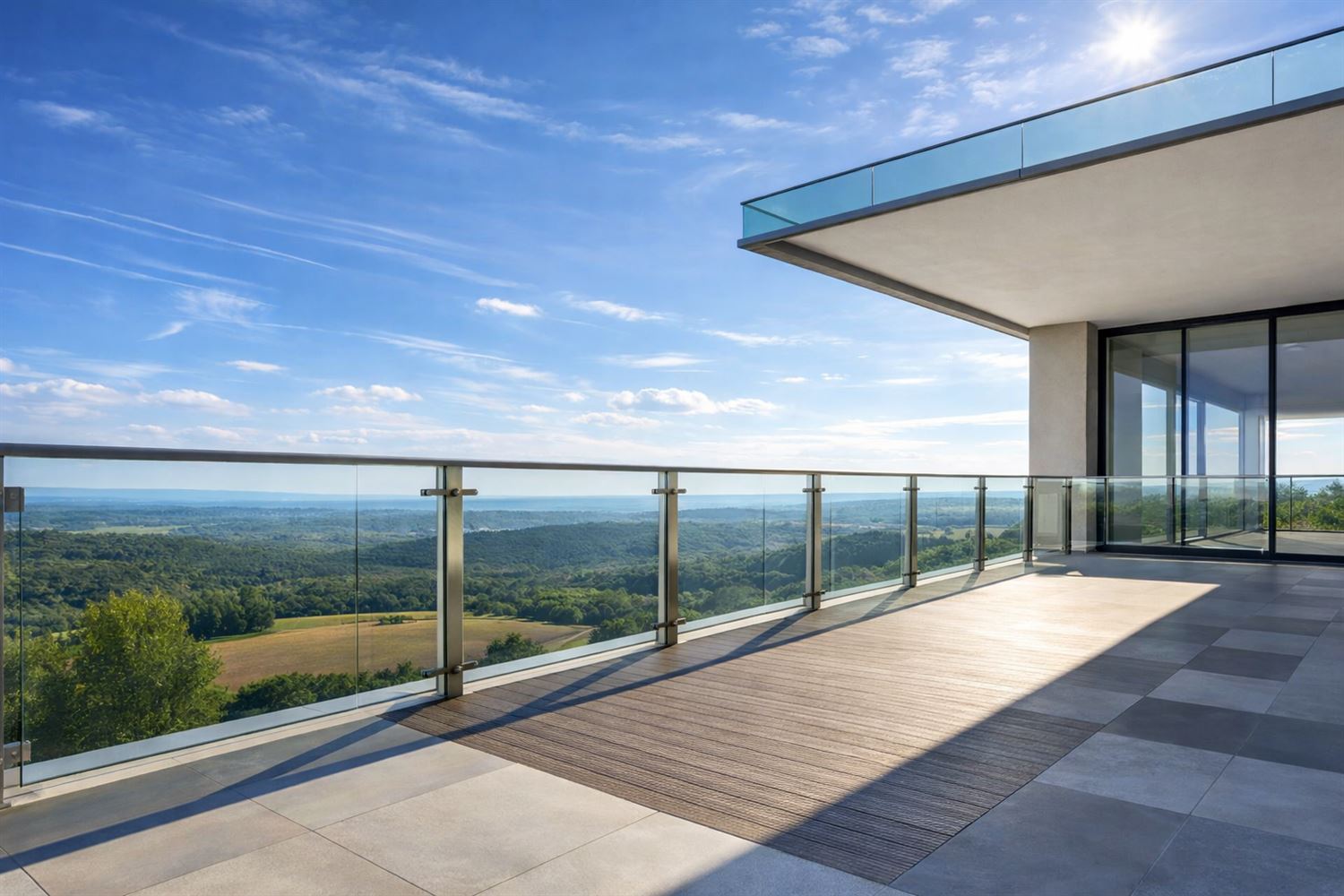
In effect, the terrace structure itself becomes the load-transfer mechanism for the balustrade and deck assembly. By separating the structural load path from the waterproofing layer, the membrane can remain continuous and protected beneath the terrace build-up.
This removes reliance on sealants and collars around penetrations - components that frequently become long-term maintenance vulnerabilities in terrace construction.
Designing for the long term
The growing interest in non-penetrative solutions reflects a broader shift in how the construction industry is thinking about building performance. Compliance at practical completion is no longer sufficient. Increasingly, clients, investors and regulators are asking how buildings will perform over decades - not just at handover.
For balconies and terraces, that means questioning whether traditional penetrative details are suitable for long-life buildings.
Effi Wolff, founder of Balconette and creator of the BalcoDeck system, said:
“Historically, penetrations through waterproof membranes were accepted as a necessary compromise to secure balustrades structurally.
The challenge with roof terraces has always been that the structural requirements of balustrades often force designers to compromise the waterproofing layer.
BalcoDeck was developed specifically to solve that dilemma. Instead of drilling through the membrane to secure balustrades, the system transfers structural loads through an engineered substructure that distributes those forces across the roof. This allows the membrane to remain intact while still achieving the structural performance required for guarding.”
About BalcoDeck
BalcoDeck is a non-penetrative roof terrace and balcony system developed by architectural systems manufacturer Balconette. The system enables balustrades and decking to be installed above waterproofed roofs without penetrating the membrane, transferring loads through an engineered substructure designed to distribute forces across the roof build-up.