Rethinking Long-Standing Roof Terrace Detailing Approaches
In construction, not every detail is actively designed. Some are inherited.
They pass from project to project, specification to specification, becoming accepted not because they are optimal, but because they are familiar.
Roof terrace detailing is a perfect example of one of those areas.
For many years, the approach to fixing balustrades and structural elements has followed a consistent logic: achieve a secure structural connection by anchoring directly into the slab. It is a method that satisfies engineering requirements clearly and predictably.
But in doing so, it introduces a secondary condition - one that sits less comfortably within the building envelope.
To achieve that structural connection, penetrations are often introduced through the waterproofing layer.
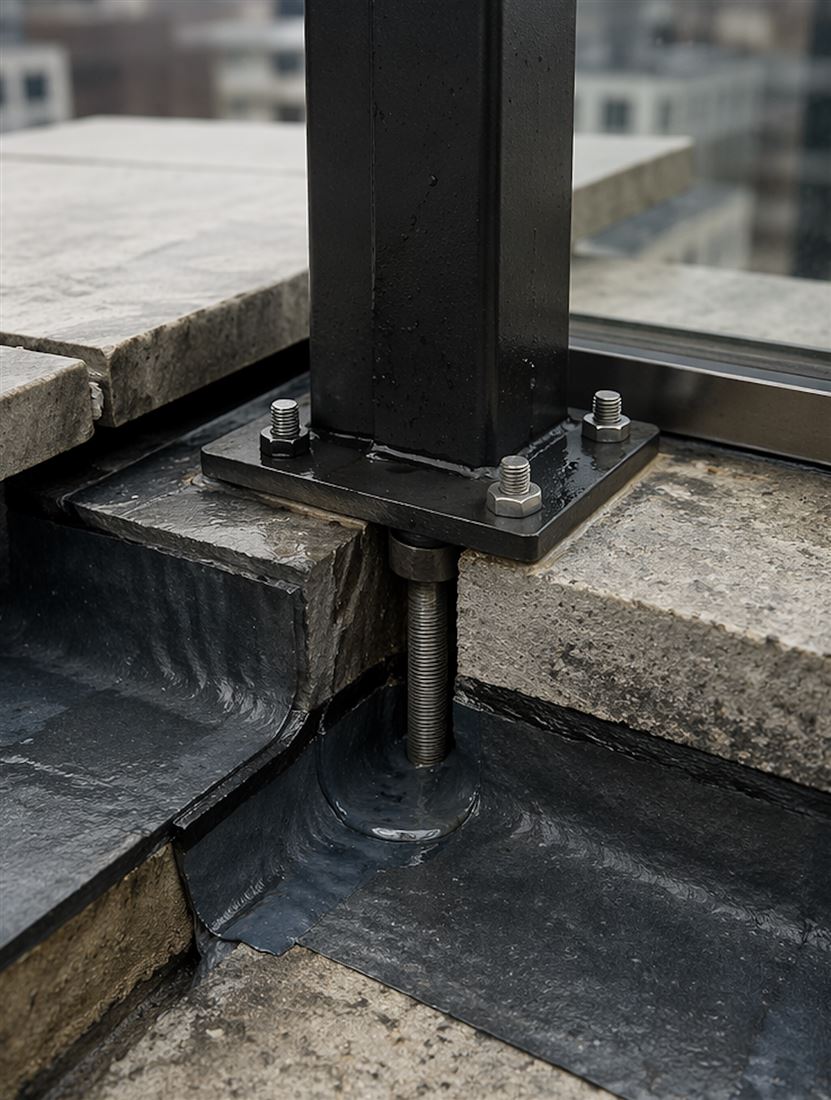
And while these penetrations can be detailed and sealed, they create interfaces that rely on long-term performance of materials that are exposed to movement, weathering and time.
What is interesting is not that this approach exists - but that it is rarely revisited
In many cases, it is treated as an accepted constraint of roof terrace design rather than a design decision in its own right.
Yet expectations around buildings are changing.
There is increasing focus on lifecycle performance, maintenance responsibility and long-term risk. Details that were once considered acceptable at completion are now being assessed in terms of how they perform years into occupation.
This raises a simple question:
If a detail introduces a known point of vulnerability into a critical part of the building envelope, should it remain the default?
Increasingly, design teams are beginning to explore alternatives that challenge this assumption.
Approaches such as BalcoDeck® reflect a shift in thinking - not by changing the requirement for structural performance, but by rethinking how that performance is achieved. By separating load transfer from the waterproofing layer, it becomes possible to meet structural demands without introducing the same dependency on penetrations.

This is not about replacing one system with another. It is about recognising that some of the most established details in construction are also the least questioned.
And that, perhaps, is where the opportunity lies.