The Thermal Bridge Your Detail Drawings Don't Show: Balustrade Fixings and Part L 2021
Every metal fixing penetrating insulated roof build-ups creates a measurable cold bridge - yet Psi-value calculations for balustrade fixings are absent from almost every roof terrace specification. Balconette sets out the compliance gap and what it means for Part L 2021
Balconette, manufacturer of the BalcoDeck® non-penetrative roof terrace system, is drawing attention to a thermal compliance gap that is quietly growing as building fabric performance requirements tighten under the Future Homes Standard and Part L 2021.
The thermal bridge at the balustrade fixing
A conventional balustrade fixing on a roof terrace consists of a steel or aluminium post baseplate bolted through the roof build-up to the structural substrate. The fixing passes through whatever insulation layer is present - typically 100–200mm of PIR board. Metal has a thermal conductivity approximately 200 times higher than PIR insulation. The result is a linear thermal bridge running through the full depth of the insulation at every fixing point.
The Psi-value - the linear thermal transmittance - of this bridge depends on the fixing geometry, the insulation depth and the materials used. For a typical 150mm PIR build-up with a steel post fixing, the linear thermal transmittance is in a range that, when multiplied across the number of fixing points on a terrace perimeter, has a measurable effect on the Target Emission Rate calculation for the building.
Part L 2021 and the TER calculation
Part L 2021 requires that building fabric performance is modelled accurately in the Target Emission Rate calculation, including the contribution of thermal bridges. The approved methodology allows either the use of default psi-values from the Accredited Construction Details library or the calculation of project-specific psi-values using recognised thermal modelling methods.
Balustrade fixings do not appear in the Accredited Construction Details library. There is no default psi-value for a steel post penetrating a flat roof insulation layer. In the absence of a default, the calculation should use a project-specific value. In practice, the fixing is omitted from the TER calculation entirely, because no one has asked the question.
The condensation risk dimension
Beyond the TER compliance question, there is a condensation risk dimension that is rarely considered. A metal fixing penetrating the insulation layer creates a local cold spot at the interface between the fixing and the building fabric on the interior side. Under BS EN ISO 13788, the surface temperature factor fRsi at this cold spot should be checked against the minimum value required to avoid surface condensation in the relevant exposure class.
On a well-insulated roof construction, the fixing penetration may reduce the local fRsi below the threshold value for the internal humidity class. This is a compliance issue under Part L and a practical performance issue: surface condensation at a concealed fixing point, beneath the deck build-up, is not something that will be observed or reported until it has caused secondary damage.
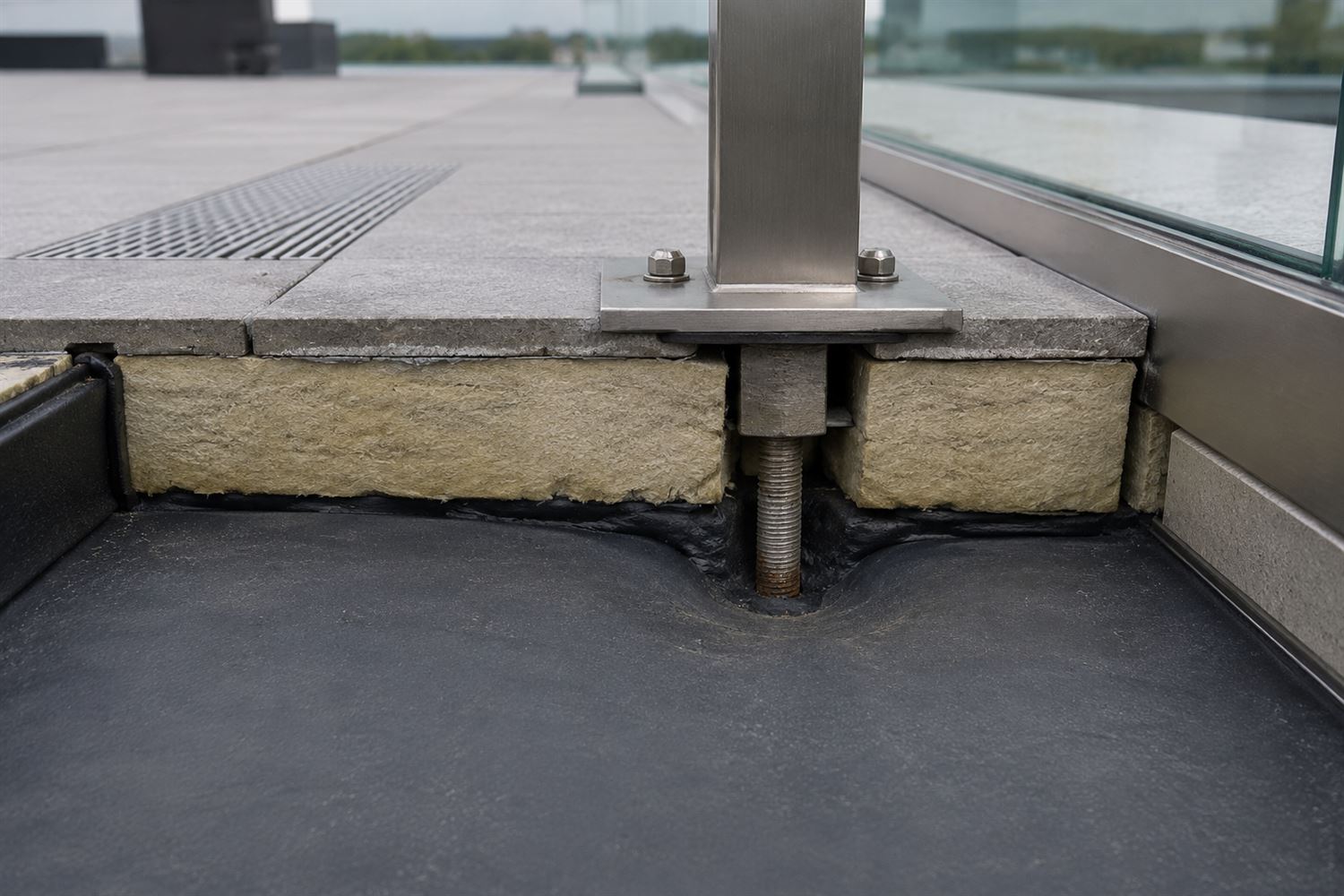
What non-penetrative fixing provides
The BalcoDeck® system eliminates this thermal bridge by design. Because the structural platform sits above the membrane and insulation layer without penetrating it, there is no metal path from the exterior fixing to the building fabric through the insulation. The Psi-value at the balustrade base is effectively zero for the purposes of the TER calculation. The fRsi compliance question does not arise.
Effi Wolff, founder of Balconette, said: “The thermal bridging question at balustrade fixings has been invisible because nobody has asked it. But as Part L 2021 tightens the fabric performance requirements and as the Future Homes Standard pushes further, the calculation gap will start to show up in compliance assessments. Non-penetrative fixing is the only approach that removes the bridge rather than trying to quantify it.”
For architects and energy assessors working on roof terrace projects, the immediate action is to raise the balustrade fixing as a thermal bridge element in the TER calculation conversation, and to request that the structural engineer or specialist confirm whether a project-specific psi-value has been calculated. If it has not, the TER calculation may be understating the fabric heat loss.