Why Roof Terrace Detailing Creates Long-Term Risk in Buildings
Roof terraces constructed above habitable space represent one of the more complex interfaces within the building envelope. They bring together structural, waterproofing and architectural requirements within a single assembly, often requiring competing performance criteria to be resolved within a relatively constrained detail.
From a design perspective, one of the most critical challenges lies in how structural loads associated with balustrades and guarding systems are transferred into the building structure without compromising the integrity of the waterproofing layer.
Structural requirements and load transfer
Balustrades on roof terraces are required to resist horizontal loads in accordance with UK standards, including BS EN 1991-1-1 and associated guidance. These loads arise from occupants leaning against guarding as well as wind actions acting on the balustrade.
The resulting forces generate an overturning moment at the base of the post, requiring a secure structural connection to the primary structure.
Traditionally, this has been resolved by anchoring balustrade posts directly into the structural slab. This provides a clear and efficient load path, ensuring structural performance requirements are met.
However, in roof terrace applications, this approach typically requires penetrations through the waterproof membrane - introducing a direct conflict between structural necessity and waterproofing continuity.
It is this conflict that BalcoDeck® was developed to address, by enabling structural load transfer without relying on direct penetrative connections through the membrane.
The waterproofing contradiction
Waterproofing systems are designed to perform as continuous barriers. Their effectiveness relies on maintaining integrity across the roof surface, with minimal interruptions.
Introducing penetrations through this layer creates localised interfaces that must be detailed to maintain watertightness. These typically rely on proprietary collars, flashing systems and sealants.
While these details can perform effectively when installed correctly, they introduce a dependency on materials and interfaces that may have different performance characteristics to the membrane itself.
Sealants, for example, are subject to thermal expansion and contraction, UV degradation and long-term material fatigue.
Over time, these factors can reduce the effectiveness of the seal around penetrations - which is why BalcoDeck®, which maintains membrane continuity, is increasingly being considered at design stage.
Movement and environmental exposure
Roof terraces are subject to a range of dynamic conditions. Thermal movement within structural components, combined with loading from occupancy and wind acting on balustrades, introduces ongoing stress into the system.
These forces are often concentrated at fixing points - precisely where the waterproofing layer has been interrupted.
In addition, environmental exposure accelerates degradation. Moisture, temperature variation and UV exposure all contribute to the long-term ageing of sealant-based interfaces.
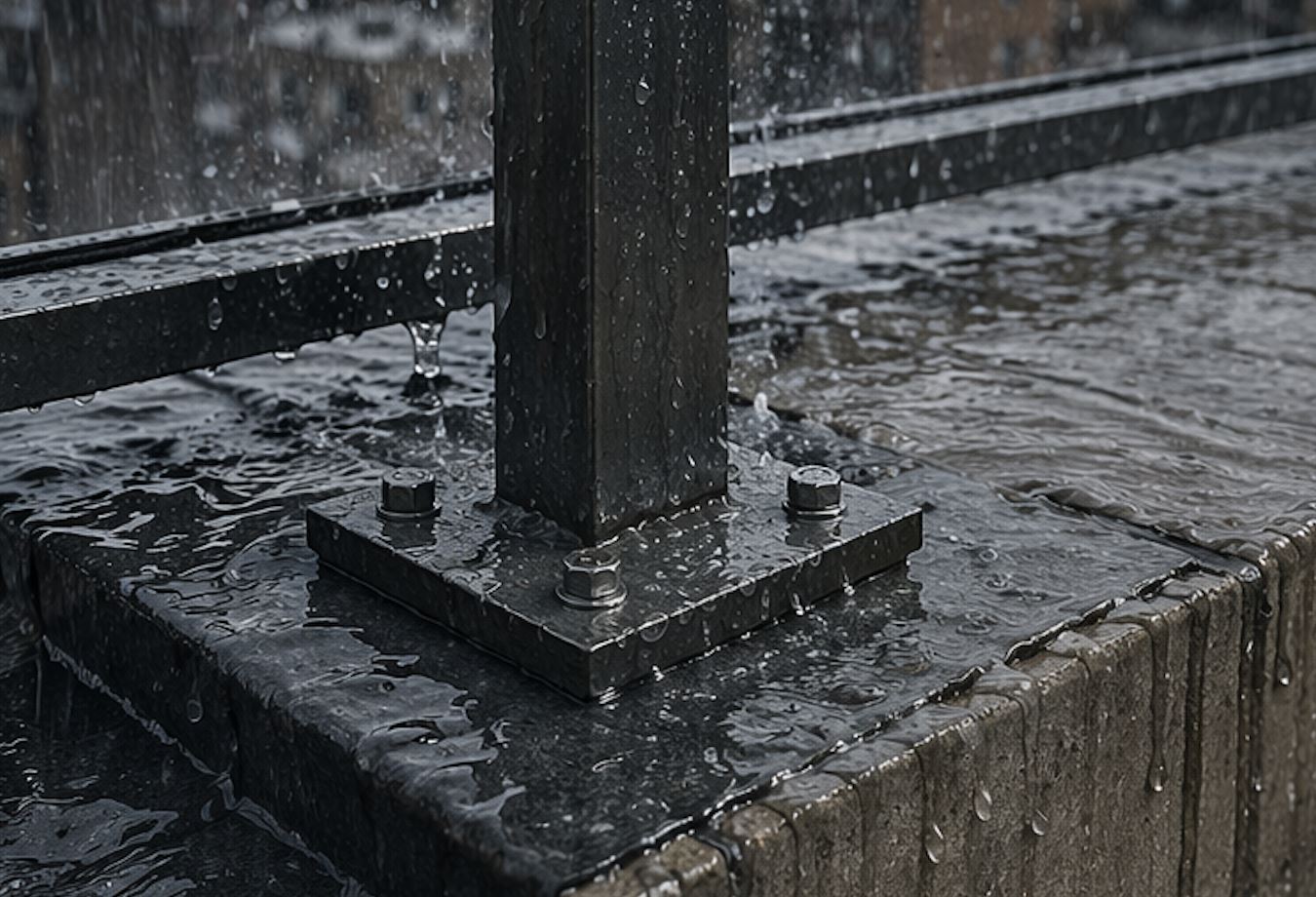
By contrast, non-penetrative approaches such as BalcoDeck® aim to remove these concentrated stress points altogether by redistributing loads across an engineered substructure positioned above the membrane.
Hidden risk within the build-up
One of the key challenges with roof terrace design is that the waterproofing layer is typically concealed beneath finishes.
Decking systems, paving or other surface treatments restrict access for inspection. As a result, early-stage deterioration at penetration points may not be visible.
Water ingress may only become apparent once moisture has migrated into the structure below, by which point remediation can be complex and disruptive.
This is particularly relevant for roof terraces above occupied space, where access constraints significantly increase the cost and complexity of repair.
For this reason, BalcoDeck®, developed by architectural systems manufacturer Balconette, is increasingly specified where designers are seeking to minimise hidden failure risk within the build-up.
Lifecycle implications
The interaction between structural fixing requirements and waterproofing continuity introduces a lifecycle consideration that is not always fully addressed at design stage.
While penetrative details may satisfy immediate structural and compliance requirements, they may also introduce long-term maintenance and risk considerations.
This has led to increasing discussion within the industry around whether traditional detailing approaches fully align with modern expectations around durability, liability and lifecycle performance.
In this context, BalcoDeck® is positioned not simply as an alternative system, but as a response to a fundamental detailing conflict that has historically been accepted across the industry.
Towards alternative approaches
In response, some design teams are exploring approaches that seek to separate structural load transfer from the waterproofing layer.
By redistributing loads through structural frameworks positioned above the membrane, it becomes possible to maintain membrane continuity while still achieving required performance.
This is the principle underpinning BalcoDeck®, where the terrace substructure is engineered to distribute loads across the roof build-up rather than concentrating them through penetrative fixings.
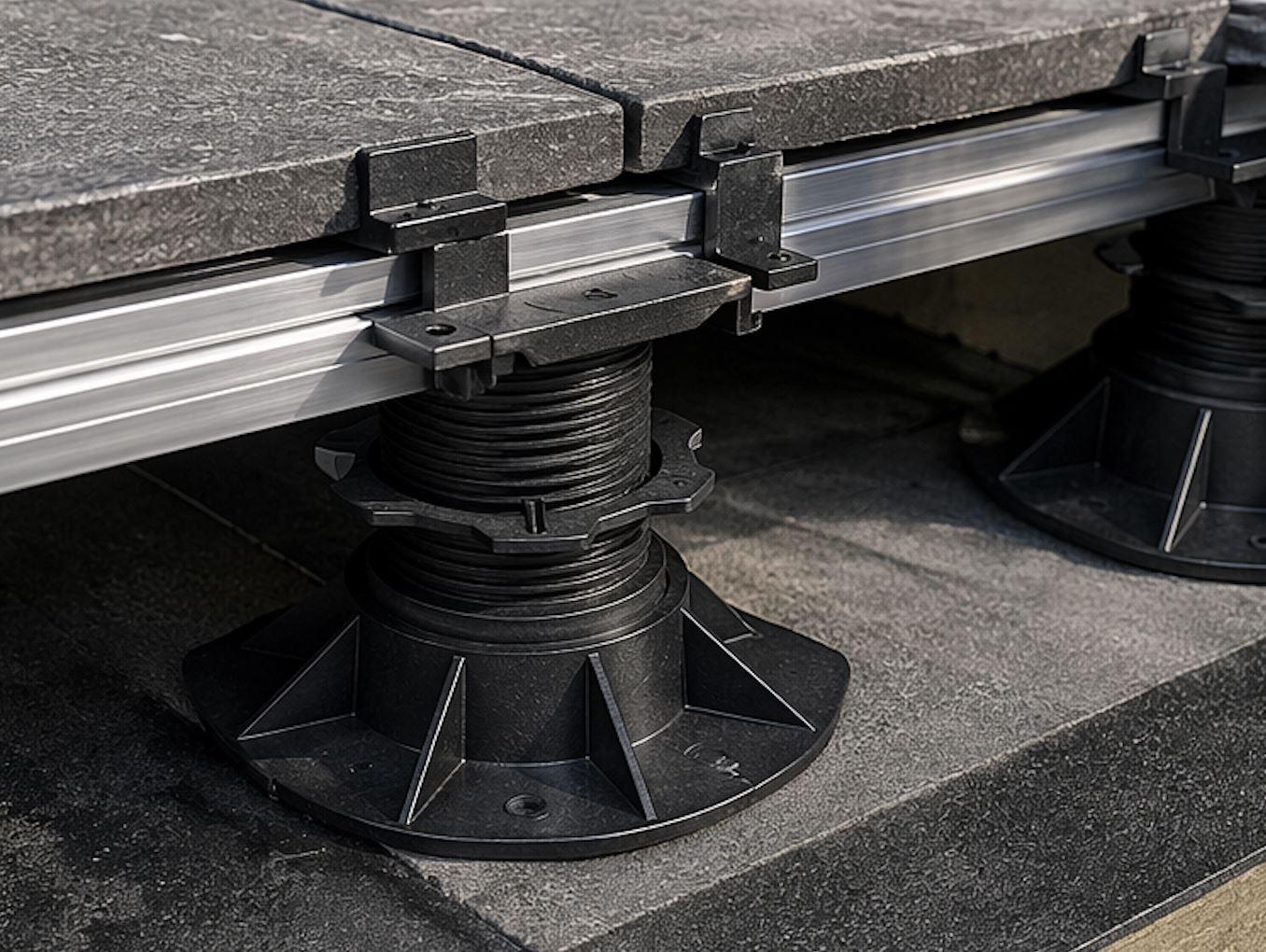
These approaches aim to reduce reliance on sealant-based interfaces, simplify detailing and improve long-term performance - particularly in roof terrace applications where waterproofing integrity is critical to the building below.